4 Best Thermal Drones That Never Lose a Deer in the Woods
You’re heading into the woods after a wounded deer, and darkness is closing in fast. You need a drone that won’t lose the track—and the four best options pack thermal sensors, obstacle avoidance, and flight times over 40 minutes. Let’s break down which one fits your hunt.
| Autel Robotics EVO MAX 4T V2 With 4 Cameras in One |  | Best Overall | Thermal Camera Resolution: 640×512 at 30Hz, 9.1mm focal length, 16x digital zoom | Temperature Measurement Range: Not specified | Maximum Transmission Range: Not specified (A-Mesh 1.0 networking) | VIEW LATEST PRICE | Read Our Analysis |
| Autel Robotics EVO Lite 640T Enterprise Bundle 866g Lightweight |  | Best Value | Thermal Camera Resolution: 640×512 at 30Hz, 9mm lens, 16x digital zoom | Temperature Measurement Range: -20°C to 550°C, ±3°C accuracy | Maximum Transmission Range: Up to 12 km (SkyLink 2.0) | VIEW LATEST PRICE | Read Our Analysis |
| Autel Robotics EVO Lite 640T Enterprise Basic Combo 866g Lightweight | 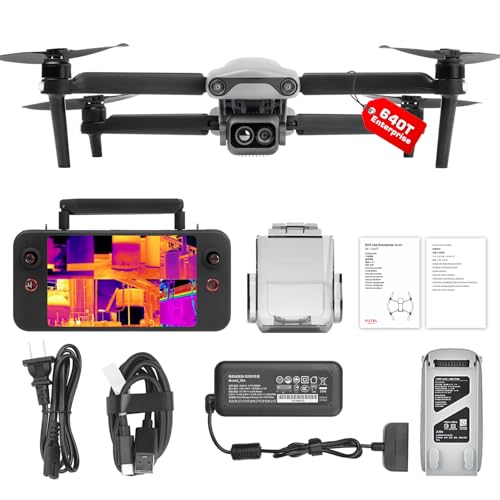 | Budget-Friendly Pick | Thermal Camera Resolution: 640×512 at 30Hz, 9mm lens, 16x digital zoom | Temperature Measurement Range: -20°C to 550°C, ±3°C accuracy | Maximum Transmission Range: Up to 12 km (SkyLink 2.0) | VIEW LATEST PRICE | Read Our Analysis |
| Autel Robotics EVO MAX 4N V2 Starlight Night-Vision/Wide/T~hermal/L~aser |  | Professional Grade | Thermal Camera Resolution: 640×512, 9.1mm focal length, 16x digital zoom, radiometric at 30fps | Temperature Measurement Range: -4°F to 1022°F | Maximum Transmission Range: Up to 20 km (SkyLink 3.0) | VIEW LATEST PRICE | Read Our Analysis |
More Details on Our Top Picks
Autel Robotics EVO MAX 4T V2 With 4 Cameras in One
If you want a professional thermal drone that does it all, this is your top pick. The Autel EVO MAX 4T V2 packs four cameras into one rugged frame: a 48MP wide camera for low light, an 8K zoom with 10x optical reach, a thermal imager (640×512 at 30Hz), and a laser rangefinder accurate to ± (1 m + D×0.15%). Its 2026 redesign improves heat dissipation and battery safety with hot swappable ABX41-D packs. You get 720° obstacle sensing from dual fisheye lenses and millimeter wave radar, so it won’t flinch near power lines or water. A Mesh 1.0 networking keeps multiple units linked for BVLOS missions. This is serious hardware for serious work.
- Thermal Camera Resolution:640×512 at 30Hz, 9.1mm focal length, 16x digital zoom
- Temperature Measurement Range:Not specified
- Maximum Transmission Range:Not specified (A-Mesh 1.0 networking)
- Visible Camera Resolution:48MP wide camera, 48MP zoom camera at 8K
- Obstacle Avoidance System:720° omnidirectional sensing, dual fisheye vision with millimeter-wave radar
- Remote ID Support:Yes
- Additional Feature:A-Mesh 1.0 networking
- Additional Feature:720° omnidirectional sensing
- Additional Feature:Hot-swappable ABX41-D battery
Autel Robotics EVO Lite 640T Enterprise Bundle 866g Lightweight
The Autel Robotics EVO Lite 640T Enterprise Bundle packs impressive thermal power into an 866g frame. You’ll love its foldable design, measuring just 210×123×95mm, so it slips easily into a backpack for solo missions.
- Thermal core: 640×512 resolution at 30Hz, measuring temps from -20°C to 550°C with ±3°C accuracy.
- Visible camera: 48MP with 16x zoom for crystal-clear detail.
- AI smarts: It learns targets over time, tracking 100+ objects on a real-time map.
Pair it with SkyLink 2.0 for a 12km range, and you’re set for search and rescue. Just remember, it supports Remote ID.
- Thermal Camera Resolution:640×512 at 30Hz, 9mm lens, 16x digital zoom
- Temperature Measurement Range:-20°C to 550°C, ±3°C accuracy
- Maximum Transmission Range:Up to 12 km (SkyLink 2.0)
- Visible Camera Resolution:48MP, 1/2-inch CMOS, 16x digital zoom
- Obstacle Avoidance System:Not specified
- Remote ID Support:Yes
- Additional Feature:SkyLink 2.0 transmission
- Additional Feature:Self-learning AI recognition
- Additional Feature:40-minute flight duration
Autel Robotics EVO Lite 640T Enterprise Basic Combo 866g Lightweight
Looking for a thermal drone that won’t weigh you down or your budget? The Autel Robotics EVO Lite 640T Enterprise Basic Combo is your answer. At just 866g, it’s lightweight and folds to 210×123×95mm, perfect for single-operator missions. You get a 640×512 pixel thermal sensor at 30 Hz, measuring temperatures from -20°C to 550°C with ±3°C accuracy. Its AI recognizes over 100 object types, projecting them onto digital maps in real time. SkyLink 2.0 delivers a 6K video feed up to 12 km, with 40 minutes of flight time. And it supports Remote ID, so you’re always compliant.
- Thermal Camera Resolution:640×512 at 30Hz, 9mm lens, 16x digital zoom
- Temperature Measurement Range:-20°C to 550°C, ±3°C accuracy
- Maximum Transmission Range:Up to 12 km (SkyLink 2.0)
- Visible Camera Resolution:Not specified
- Obstacle Avoidance System:Not specified
- Remote ID Support:Yes
- Additional Feature:6K real-time video feed
- Additional Feature:Remote Controller SE V2
- Additional Feature:40-minute flight duration
Autel Robotics EVO MAX 4N V2 Starlight Night-Vision/Wide/T~hermal/L~aser
Professional grade from top to bottom, the Autel Robotics EVO MAX 4N V2 is built for serious nighttime missions. You get a Starlight night-vision camera that sees in near darkness (0.0001 LUX) and spots light sources up to 5 km away. Plus, there’s a 50 MP wide camera, a 640×512 thermal sensor, and a laser rangefinder accurate to ±1 meter. It features anti-jamming modules and A-Mesh 1.0 networking for drone-to-drone communication. Hot-swappable batteries keep you airborne longer. This isn’t just a drone; it’s your covert reconnaissance partner for tracking deer through thick cover.
- Thermal Camera Resolution:640×512, 9.1mm focal length, 16x digital zoom, radiometric at 30fps
- Temperature Measurement Range:-4°F to 1022°F
- Maximum Transmission Range:Up to 20 km (SkyLink 3.0)
- Visible Camera Resolution:50MP, 1/1.28 CMOS
- Obstacle Avoidance System:Binocular vision with millimeter wave radar, perceives objects as small as 0.5 inches
- Remote ID Support:Not specified
- Additional Feature:Starlight night-vision camera
- Additional Feature:SkyLink 3.0 transmission
- Additional Feature:A-Mesh 1.0 networking
Factors to Consider When Choosing a Thermal Drone for Deer Recovery
When you’re picking a thermal drone for deer recovery, four key specs will make or break your success: thermal camera resolution, flight time, weight, and obstacle avoidance. You’ll also want rock-solid transmission range, because a lost signal in dense woods is a lost blood trail. So, let’s break down each factor so you can choose a drone that works as hard as you do, without breaking your back or your budget.
Thermal Camera Resolution
If you’re scanning thick brush or a snow-dusted hillside for a wounded deer, the thermal camera’s resolution is the single biggest factor in whether you spot a faint heat blob or just a confusing cluster of rocks. Higher resolution, like 640×512 pixels, delivers finer detail. That means you’ll actually see the deer’s shape, not a vague smear. This clarity helps you differentiate a deer from other heat sources, cutting down on false positives. Plus, you’ll identify targets at greater distances, making large-area searches way more efficient. Resolution directly boosts your night missions by capturing crisp heat data. So don’t skimp here. A higher resolution sensor turns a frustrating search into a quick recovery.
Flight Time Duration
Since you’ll often be covering large swaths of forest or rough terrain in the dark, flight time is your lifeline. Aim for at least 30 to 40 minutes per battery; that gives you a solid window for a thorough recovery mission. Shorter flight durations force you to swap batteries constantly, which disrupts your search rhythm and risks losing that faint thermal signal. Battery capacity directly dictates this duration, so look for larger packs or hot-swappable designs. With a hot-swappable system, you just swap and go, no downtime. It’s a game changer when you’re tracking in the cold or rain. Remember, longer flight time directly boosts your chances of finding the deer before dawn or weather shifts. Just balance that endurance with overall drone weight for field use. You’ll want every minute you can get!
Weight and Portability
Flight time matters, but you can’t use it if you can’t get the drone to the field. That’s where weight and portability come in. You’ll want something light, around 866 grams, so it’s easy to carry through dense woods without tiring you out. A compact, foldable design, roughly 210×123×95mm, slips right into your pack or glovebox.
And here’s the payoff: reduced weight directly boosts flight time, keeping your drone airborne longer during those critical recovery hours. It also makes manual control less of a workout, especially in tight spots or uneven terrain. Quick setup is key for time sensitive tasks like locating a deer, and a portable drone gets you in the air fast. No bulky gear, no wrestling with cases. Just grab, deploy, and go. That’s the advantage you need when every minute counts.
Obstacle Avoidance Systems
When you’re deep in the woods at night, straining to spot a heat signature through the trees, the last thing you need is a drone that smacks into a branch and ends your search in seconds. That’s why you want a system with advanced obstacle avoidance. Many top models use dual fisheye cameras paired with millimeter-wave radar for 720° omnidirectional sensing. You get laser rangefinders with accuracy as tight as ± (1 meter + D×0.15%), covering distances up to 3,737 feet.
But the real game-changer is AI that assesses your environment in real time. It enables autonomous navigation, even in GPS-denied, complex settings. Multi-sensor fusion (visual, infrared, and radar) boosts recognition and cuts collision risk. For night-time deer recovery, this tech isn’t a luxury—it’s your safety net. So prioritize drones with robust obstacle avoidance; your recovery mission depends on it.
Transmission Range Reliability
4 key factors determine transmission range reliability when you’re choosing a thermal drone for deer recovery. First, look for a system like SkyLink 2.0 or 3.0 that pushes range up to 12 km, so you don’t lose signal over sprawling woods. Second, dual-signal, anti-interference tech fights through RF obstacles like dense foliage or urban clutter, keeping your connection stable. Third, demand data integrity with latency below 150 ms; that’s your real-time thermal feed staying crisp for tracking. Fourth, AES-256 encryption and optional 4G boost secure long-range communication for sensitive recovery missions. And remember, environmental factors like thick trees or buildings can weaken signals, so robust technology isn’t optional. Want reliable deer recovery? Prioritize these specs!