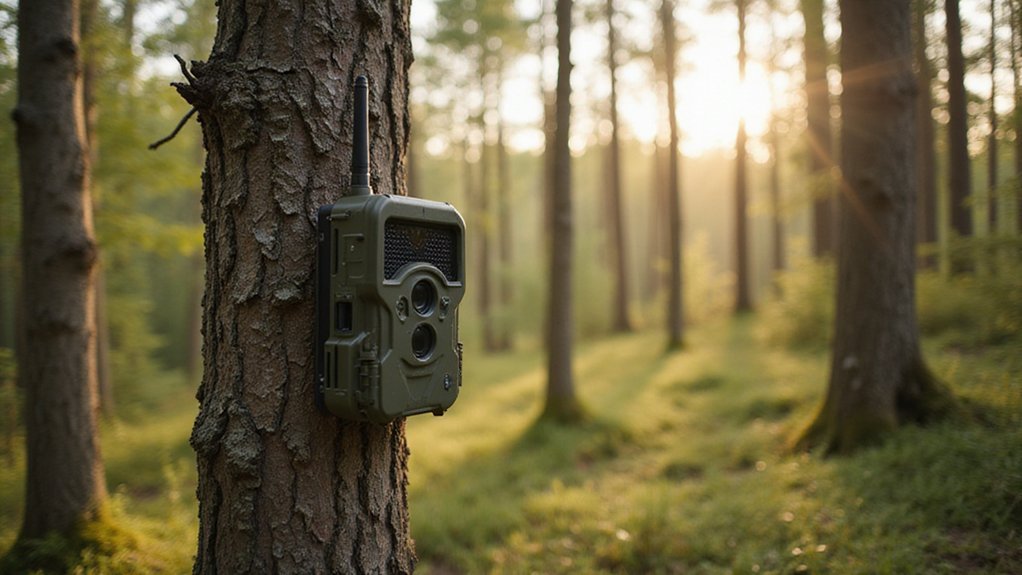
How Much Does a Cellular Trail Camera Cost Per Month?
Wondering how much a cellular trail camera will cost you each month?
The price varies, typically between $5 and over $20 per camera, depending on your plan.
The more cameras you use and the higher your photo caps, the more your costs can add up.
Keep reading to find out how to match your plan to your trail activity and avoid surprises.
The Real Monthly Cost: $5 to $20+ Per Camera
The real monthly cost for camera service ranges from about $5 to over $20 per camera. For casual check-ins, you might pay as little as $5, but active monitoring typically pushes costs toward $10 to $20 or more monthly. Entry-level plans start around $4.99 and usually cap at about 250 photos, suitable for quick glances but not frequent checks. Mid-tier plans around $10 increase your limit to roughly 1,000 images, offering more flexibility. Unlimited plans fall between $12.99 and $16.99, perfect if you want continuous access without worrying about limits. Unlike night vision goggles, which rely on ambient light to function and fail in complete darkness, cellular trail cameras use their own infrared illumination to capture images regardless of light conditions. However, if you need to adjust camera settings or view live feeds remotely, you will need a reliable AGM thermal connection to your phone for proper setup and monitoring. Many modern cellular trail cameras also feature sensor technology that detects motion and heat signatures, triggering captures even when the target is stationary.
Keep in mind that camera durability and signal strength heavily influence your costs. Harsh weather or remote locations that weaken signals can lead to additional charges for retries or extra data usage. Light users of the service can stay near the $5 range, while video-intensive setups that transmit large files may quickly surpass $20 per month. You’re paying for convenience and continuous access, not just the hardware itself. Some providers, like Spy Point, start with 100 free photos before requiring a paid plan.
How Camera Count Changes Your Monthly Bill
Your monthly bill can vary significantly depending on how your camera plan is structured. Some brands charge a flat fee per camera, meaning your costs increase linearly as you add more units. For example, Muddy charges $20 for the first camera and $15 for each additional one. On the other hand, shared plans like Moultrie Mobile’s Pro Series Unlimited tend to offer cheaper per-camera rates once you reach a certain number. When you have four or more cameras with this plan, the cost drops to $7.99 per camera. Unlike cellular trail cameras, night vision and thermal technology does not require a monthly subscription but is typically more expensive upfront. For those seeking the best value, reviewing a guide to top game cameras can help you compare quality and performance alongside plan costs. Building your own device with a thermal drone requires a similar upfront investment in components rather than ongoing fees.
At four cameras, your total monthly cost can range from $20—if you’re on a per-camera plan—to over $80 if you’re paying the full rate for each camera individually. It’s important to note that features such as camera quality and weatherproofing do not impact your monthly bill. Instead, the way your plan is designed does. Always compare different plans and check if there are discounts for adding extra cameras before you commit.
How Low Photo Caps Drive Up Your Effective Cost
Low photo caps can silently drive up your actual spending. When a plan only allows 100 or 250 images per period, you may find yourself quickly reaching that limit, especially on busy trails. TrailCamHQ points out that active trails can consume these photos in just days. A cheap $5 plan offering 250 photos might seem like a good deal, but once your camera hits the cap, you’ll need to upgrade sooner than expected. That upgrade becomes an unavoidable expense—it’s less about choosing a better plan and more about escaping a useless one. Your effective cost per photo then skyrockets once you factor in overages or forced tier jumps. For instance, Moultrie’s 1,000-image plan at $9.99 tends to spread out the cost better than Spypoint’s free 100-photo tier, which offers very limited coverage for active properties. Keep in mind that night vision cameras, unlike human eyes that do not glow under night vision, rely on infrared illumination to capture images, so your plan’s photo cap still applies regardless of lighting conditions. When shopping, focus on the photo cap size rather than just sticker prices to avoid hidden costs. Many users overlook data overage fees that can quickly inflate monthly bills when the cap is exceeded. For a similar reason, buyers of night vision binoculars with cameras must also assess how device image quality and storage limits affect their overall expense.
Free and Low-Cost Plans Under $10 a Month
Several cellular trail camera plans under $10 a month provide a budget-friendly entry point. SPYPOINT and Wildgame Innovations both offer free plans that deliver 100 photos each month, allowing you to test the system without spending any money. Once you reach that cap, extra images are stored on your SD card, helping conserve battery life. Similarly, quick connect on Stealth Cam devices simplifies pairing your camera to the cellular network, reducing setup time and ensuring a stable connection. Understanding the thermal imaging capabilities in the TU651 LRF scope can also help decide if similar detection technology suits your needs. For those prioritizing long field life, selecting a model with efficient power management can reduce how often you need to swap out batteries.
If you need more images, you can upgrade to a $5 plan. SPYPOINT offers 250 photos, while Muddy’s plan provides 650—enough for light scouting. For slightly higher budgets of $8 to $10, SPYPOINT’s 500-photo plan or Moultrie Mobile’s 1,000 photos plus 10 videos are suitable for more active setups. Paying $10 annually with SPYPOINT can even unlock unlimited photos, reducing your monthly costs significantly. Choosing reputable brands like SPYPOINT helps protect your investment and ensures reliable service.
How to Match Your Budget to Your Trail Activity
Matching your camera plan to your trail activity depends on how many photos you expect to capture each month. For light activity trails, a plan with around 250 photos at approximately $5 per month should suffice. Moderate trails that produce about 1,000 images typically require a plan costing $9 to $10 per month. If your trails are busy and produce more than 1,000 images, especially if you’re capturing videos, an unlimited plan ranging from $13 to $20 per month is recommended. For trails with unpredictable activity, consider a camera that offers advanced night vision to ensure clear captures without requiring a higher photo allowance.
Battery life also affects your plan choice. Shorter battery life on active trails means you’ll want a plan that maximizes photo uploads without wasting your monthly allotment. To optimize coverage and manage costs, consider creating coverage zones across your property. Using multiple cameras? Look for tiered discounts for multiple units, such as Stealth Cam’s decreasing per-camera pricing. This approach helps reduce overall costs as your camera network expands. Always calculate your total monthly expenditure based on all cameras, not just individual units. For additional savings, consider how night vision goggle pricing principles apply to high-tech gear investments.
Keep in mind that some camera models, like the Spypoint Flex-M, offer instant mode as a premium feature that delivers real-time photo delivery but can quickly drain your monthly photo allowance if your trail is active.