Do Night Vision Goggles Work in Total Darkness?
Wondering if night vision goggles can see in total darkness? The answer depends on what type you’re using.
Standard night vision needs some ambient light to work, while thermal imaging and infrared technology can see without any light at all.
Keep reading to find out which option fits your needs best.
Does Night Vision Work in Total Darkness? (No, Standard Fails)
Night vision devices do not work in total darkness unless equipped with an infrared illuminator. This device acts like an invisible flashlight, emitting IR light that your goggles can detect and convert into a visible image. When activated, it turns your passive night vision into an active system capable of functioning in pitch-black conditions. Without this built-in or attached IR illuminator, your goggles will be useless in complete darkness. This active system is similar to how a Stealth Cam Quick Connect function streamlines device setup by automating a critical detection process. Infrared illuminators emit light in the near-infrared spectrum, which is invisible to the human eye but detectable by night vision sensors. Depending on your needs, thermal imaging may be a better option for detecting heat signatures rather than relying on ambient or IR light.
Why Does Traditional Night Vision Fail in Pitch-Black Conditions?
Traditional night vision fails in pitch-black conditions because it depends on ambient light to function. These devices amplify existing photons, but when no light is present, there are no signals to boost. Without photons hitting the photocathode, the intensifier tube cannot convert light into electrons, rendering the device useless. Instead of producing a clear image, it amplifies electronic noise, resulting in a grainy, indistinct picture. Your eyes also struggle in total darkness: pupils dilate to catch any stray light, but with none available, this adaptation offers no help. Additionally, your rods—responsible for black-and-white vision in low light—take over from cones, causing your perception to shift entirely to shades of gray. In pure darkness, even biological abilities to see fail, making standard night vision equipment ineffective when there’s no light to amplify. This is similar to how game cameras rely on ambient light to trigger their sensors, as they do not create their own illumination to capture images in complete darkness. Building a thermal camera provides an alternative that detects heat rather than light, allowing vision in total darkness. For those seeking a practical workaround, assembling a DIY drone with a thermal imaging payload can offer a cost-effective way to survey dark environments without relying on photon amplification.
Can an Infrared Night Vision Workaround Fix Zero-Light Rooms?
Yes, infrared night vision can work effectively in zero-light rooms. These devices do not rely on any visible ambient light; instead, they emit infrared light that illuminates the area. Your goggles then detect the reflected IR light and generate a visible image, allowing you to see clearly even in total darkness. This active illumination method makes digital IR night vision especially useful for windowless spaces like basements or bedrooms where natural or external light is absent. Since the room stays completely dark to the human eye, it provides a discreet way to monitor or navigate dark environments without relying on visible light sources.
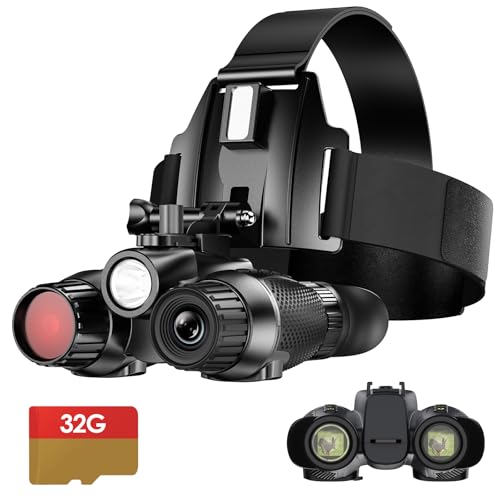
【3D Naked-Eye Effect】Enjoy clear and detailed 3D virtual reality night vision with dual-screen, dual-eyepiece naked-eye 3D viewing. Capture stunning 36MP photos and ultra-high-definition videos.
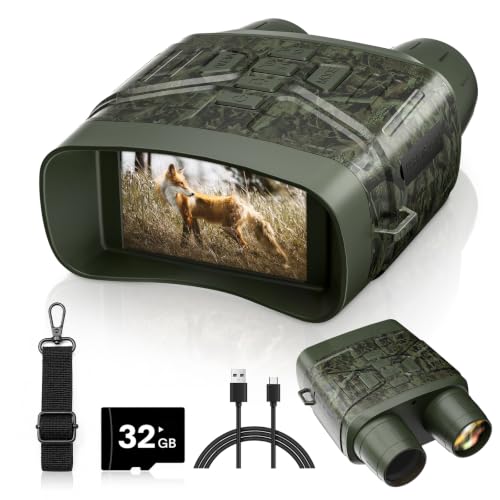
Day and night viewing: Use these night vision goggles in daylight, low light, or complete darkness. The 850nm infrared illuminator provides clear black-and-white viewing at night for hunting, wildlife observation, camping, and property monitoring.
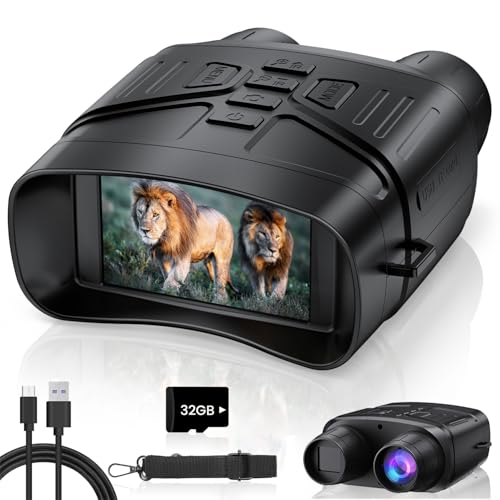
Day and night viewing: Use these night vision goggles in daylight, low light, or complete darkness. The 850nm infrared illuminator provides clear black-and-white viewing at night for hunting, wildlife observation, camping, and property monitoring.
How Does Thermal Imaging See in Complete Darkness?
Thermal imaging can see in complete darkness because it detects heat instead of visible light. Every object emits infrared radiation proportional to its temperature. Your thermal sensor captures this infrared energy through Infrared detection. Instead of relying on reflected light, it measures thermal contrast—the temperature differences between warm objects and cooler backgrounds. Microbolometer sensors form the core of this detection, converting heat into electrical signals without needing any light source.
In dark environments, this contrast remains because heat emission is unaffected by the absence of light. For example, people and vehicles stand out clearly against cooler surroundings, even in total darkness. The sensor converts the heat information into electrical signals, which a processor then translates into a grayscale image. Warmer objects appear brighter, while colder areas look darker.
Thermal imaging does not depend on ambient light, so smoke, fog, or darkness do not impede visibility. However, thick walls block infrared signals, preventing detection behind solid barriers. While thermal imaging excels at spotting heat signatures, it cannot read labels or display fine visual detail. In essence, complete darkness does not limit your ability to see with thermal imaging, since it relies solely on thermal radiation.
Can Digital Night Vision Handle Complete Darkness Better?
Digital night vision can handle complete darkness much better than analog counterparts, but only because it actively generates its own infrared light. Unlike passive image intensifiers that need at least a few photons to produce an image, digital systems depend on infrared illumination. An IR flashlight projects invisible light onto objects, which then reflects back to the sensor, allowing the device to create a black-and-white image in total darkness. Without this active IR source, a digital unit still needs some photons to operate and cannot generate details out of nothing. In practical use, digital night vision performs well in sealed, dark environments or on moonless nights when IR illumination is active. However, image quality can become grainy if reflected IR light is weak, and battery life decreases faster because the IR illuminator consumes more power. This device also supports seven IR infrared levels for fine-tuning brightness in complete darkness.
Which Night Vision Device Should You Trust in Absolute Darkness?
Thermal imaging is the most reliable choice in absolute darkness because it detects heat signatures rather than relying on ambient light. Unlike traditional night vision devices that need some form of illumination, thermal cameras work flawlessly in complete blackness by sensing temperature differences. This makes them ideal for detection purposes, spotting warm objects against cooler backgrounds without any external light source. Keep in mind, though, that thermal imaging sacrifices fine detail; it provides essential recognition and detection but not the crisp identification of individual features or small details. For applications requiring precise identification, infrared (IR) night vision with an illuminator can be more effective, as it projects its own infrared light to enhance visibility. However, active IR illumination risks alerting your presence to others who can detect the emitted infrared signal. Conversely, traditional image-intensifier night vision devices depend on ambient photons and become useless in true blackout conditions where no light exists at all. These devices rely on a photocathode to convert photons into electrons for amplification, but without any photons to start the process, they cannot function. When choosing a device for total darkness, consider options like the best night vision camcorders that offer both thermal and infrared features for versatile use.