When Were Night Vision Goggles Invented?
Ever wondered when night vision goggles first came into being? The story actually starts during World War II, when researchers developed early infrared systems that were bulky and primitive by today’s standards.
These inventions proved the idea was possible, paving the way for the compact, powerful night vision gear you see now. Keep reading to learn how these devices evolved from their humble beginnings.
The First Night Vision Goggles Emerged From World War II
The first practical night vision goggles emerged from military necessity during World War II. These early devices, pioneered primarily by Germany and the United States, relied entirely on infrared technology. The German army deployed the first combat systems in 1939, which used powerful, truck-mounted searchlights to illuminate targets, as these devices were too bulky for portability. The Zielgerät 1229 “Vampir” system, introduced around 1945, was a heavy pack carrying a rifle-mounted scope for infantry use. Meanwhile, the U.S. developed similar active-infrared devices, creating prototypes that demonstrated the feasibility of night fighting. Innovative military optics like the StG 44 rifle could be equipped with these systems for enhanced night operations. This early reliance on infrared illumination is a key difference when comparing night vision vs. thermal technologies. Modern thermal monoculars for hunting now leverage these foundational thermal principles in compact, handheld devices. Despite their limitations, such as weight and size, these systems proved the concept and laid the groundwork for future advancements in night vision technology, including the development of image intensifier tubes.
How Generation 0 Goggles Used Active Infrared Light
Generation 0 goggles relied on an active infrared system, which you can think of as a flashlight invisible to the human eye. To operate, you needed a large external illuminator that projected an infrared beam toward your target. The goggles’ lens then detected the reflected infrared light and converted it into a visible image. This system was highly dependent on that external source; without the illuminator, the goggles could not produce a usable image at all. Because the infrared light was invisible to the naked eye, enemies equipped with similar gear could also detect your position by observing the infrared emissions. Typical examples from this era, such as the Soviet-designed PNV 57A, were often mounted on tank crew helmets and paired with powerful vehicle-mounted infrared searchlights.
However, this active design introduced significant limitations. The entire setup was bulky, featuring a sizable illuminator and a heavy power supply carried in a backpack. These components made mobility cumbersome and impractical for extended field operations. As a result, users faced restrictions on movement and operational duration, highlighting the era’s technological constraints and the early, less refined nature of infrared enhancement gear. Modern enthusiasts even apply similar thermal imaging principles in projects like building a thermal drone. Modern thermal imaging technology solves these issues by detecting heat signatures passively. For modern users, understanding night vision pricing factors can provide insight into the evolution from these cumbersome early systems to today’s advanced gear.
Generation 1 Goggles Introduced Passive Light Amplification
Passive night vision with Generation 1 goggles offered a significant leap forward by amplifying existing ambient light. Developed by the US Army in the early 1960s, these “Starlight Scopes” could increase moonlight or starlight by approximately 1,000 times. This capability allowed for covert movement in low-light conditions without actively emitting infrared flashes, making it a stealthier option compared to earlier active-IR systems. The operation relied entirely on available natural light sources, resulting in a green-tinted image displayed through the S-20 photocathode tube. However, the image resolution was relatively low, and effective range was limited, generally reaching only about 100 yards. Modern top-rated night vision devices offer vastly improved clarity and performance over these early models. Manufacturing these image intensifier tubes proved complex, presenting significant technical challenges and driving up production costs. The units were bulky and required heavy batteries to power the high-voltage systems, making them less portable and more cumbersome for field use. Thermal cameras, for example, cannot see through solid walls due to thermal imaging limits. Modern devices have evolved significantly, with specialized rhino mounts for NVG enhancing stability and compatibility for contemporary users.

🔦【A MUST-HAVE FOR EXPLORERS】Night Vision Goggles, tailor-made for little explorers! Our Night Vision Goggles for kidsLED beam provides a clear view in the dark, making children's night adventures more exciting and fun. Playing as a spy or agent, exploring the secret world in the dark, every mission becomes immersive and fun!

WIDE FIELD OF VIEW – 1× magnification and 40° wide-angle field of view for close-range night awareness up to 90yd, plus 2× digital zoom. Green filter option included for your preferred viewing experience. Ideal for airsoft, tactical use and camping.

【Display Model】: The Gayontech Four-Tube Binocular Night Vision is just a Dummy Model with no function, can be used for display or cosplay
Generation 2 Sharpened Images With Microchannel Plates
Generation 2 microchannel plates (MCPs) revolutionized night vision by providing a light gain of approximately13 20,000 times. This microstructure amplifies incoming photons as electrons cascade through countless tiny channels, significantly boosting image brightness and detail. For example, users might see foreign object artifacts appear as small, bright dots or streaks within the amplified image. The compact design replaces bulkier stacked tube systems, enabling the creation of the first truly handheld night vision goggles. Because MCPs operate passively, they do not require active infrared illuminators, allowing for covert observation even in complete darkness. Their enhanced image clarity and higher resolution extend to the edges of your view, making peripheral scenes sharper and more distinct. Additionally, the spectral sensitivity of these devices broadens into the near-infrared range, approximately 350 to 900 nanometers, which means you can see clearly through clouds and in extremely dark environments without additional illumination. The necessary components and assembly logic are not dissimilar from constructing a trail camera security box. Manufacturing methods like the double draw technique made producing these complex plates more economical. This foundational technology paved the way for modern monocular and binocular systems.

4K Video and Photos for Day and Night Use: GOYOJO night vision goggles capture crisp 4K video with audio and high-resolution 36MP photos, helping you record clear details during nighttime exploring, wildlife observation, camping, farm security, and outdoor patrol use.

Ultra-Clear 2K Resolution – See What Others Can’t: GOYOJO GNG2K Night Vision Monocular delivers sharp 2688x1520 HD night vision with a smooth 60Hz refresh rate. Whether you’re securing your property, spotting coyotes at night, or navigating a pitch-dark trail, you’ll enjoy crystal-clear visuals without lag or blur — even in total darkness.

LIGHT FILTERING GREEN LENS TECHNOLOGY: our Night Vision Glasses feature cool, high-tech green lenses that make nighttime vision astonishingly clear
The PVS-5 Became the First Standard Military Goggle
The PVS-5 was the first standard military night vision goggle, officially adopted in 1972. Its introduction marked a significant shift in night vision technology, moving from large, scope-style devices to wearable binocular goggles. The dual-tube stereoscopic system provided depth perception, greatly enhancing situational awareness compared to earlier equipment. Although heavy and somewhat bulky, the PVS-5 became the standard for Army aviation by 1973 and was rapidly issued to ground forces. It primarily relied on ambient starlight and an integrated infrared illuminator to help users see in low-light conditions. This reliance on recording ambient light is a principle shared with modern observation tools. Successfully deploying such gear, whether for surveillance or wildlife monitoring, often requires a thorough step-by-step guide to master its features and settings. The widespread deployment of the PVS-5 set a new precedent for military night vision gear, establishing the template for future designs and standard issue equipment. Choosing the right equipment, much like selecting the proper trail camera technology, depends heavily on the specific environment and mission requirements.
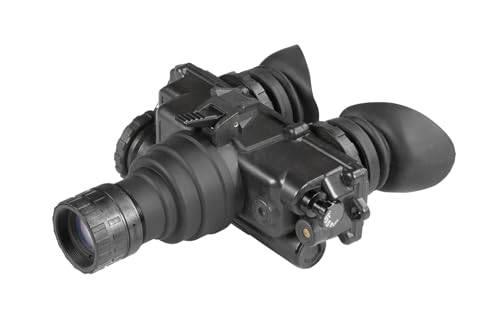
U.S. Military-Grade Night Vision Reliability: Crafted to meet the rigorous demands of the U.S. Military, the AGM PVS-7 night vision goggles deliver unmatched performance and dependability in the field. This rugged, battle-proven device is your trusted companion for secure and precise night operations

AGM PVS-14 is a rugged, multi-purpose night vision monocular used globally in challenging environments.

[HD Clarity for Outdoor Exploration]: Enhance your adventures with the GOYOJO head-mounted night vision monocular, perfect for activities like wildlife observation, camping, or nighttime exploration. Capture every moment in HD video and photos, ensuring sharp, high-quality visuals even in the dark. Whether you're tracking animals in the wild or navigating a campsite, this monocular delivers the detail you need.
Generation 3 Revolutionized Performance With Gallium Arsenide
Gallium arsenide photocathodes significantly improved night vision performance by offering maximum quantum efficiency, amplifying light by “/50000) times This enhancement allowed you to see sharper, more detailed images with resolutions exceeding 64 line pairs per millimeter and an improved signal-to-noise ratio. The auto gating technology further protected the device from bright light flashes, preventing damage and maintaining image stability. As a result, passive systems could operate reliably in near-total darkness without relying on bulky infrared illuminators, representing a major leap forward in military night vision capabilities. This advancement laid the foundation for critical choices in modern gear, such as comparing PVS-14 vs. PVS-15 systems. Understanding thermal imaging technology provides important context for these advances in light-amplifying systems.
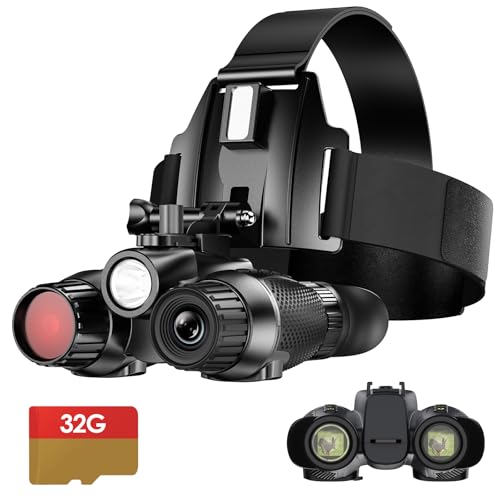
【3D Naked-Eye Effect】Enjoy clear and detailed 3D virtual reality night vision with dual-screen, dual-eyepiece naked-eye 3D viewing. Capture stunning 36MP photos and ultra-high-definition videos.

【4K Video and 40 MP Photos】Record 4K video and take 40 MP photos during daytime or nighttime observation, so you can revisit wildlife sightings and activity that would otherwise be missed. Files are stored on a compatible microSD or TF card; card not included

Enhanced Visual Clarity: 1.54" HD high definition large screen with wider viewing range, equipped with 7x high magnification telescope and 20mm adjustable focus high transmittance photosensitive lens, making it easier to search and find farther targets
How Night Vision Goggles Expanded to Civilian Use
Night vision goggles became accessible to civilians primarily after military surplus and early Generation 1 devices entered the market following the Vietnam War. These devices originally served military and law enforcement purposes but quickly found their way into civilian hands. Hunters and outdoor enthusiasts embraced them for nighttime activities such as wildlife observation and camping. During the 1990s, manufacturers introduced more affordable, consumer-oriented models with improved image quality, making NVGs available at retail stores. Regulations, such as those concerning specific light wavelengths, have shaped their availability and use. Now, you can find these devices used for home security, wildlife spotting, or personal protection. For activities requiring hands-free operation, many users find that a helmet-mounted night vision system provides the greatest convenience and stability. When choosing a device, it’s important to understand the different generations of night vision technology to match performance to your needs. Civil aviation and perimeter security sectors also adopted NVGs to enhance safety during night flights and during night-time monitoring. This widespread civilian access transformed night vision technology from a specialized military tool into a versatile resource for everyday use.
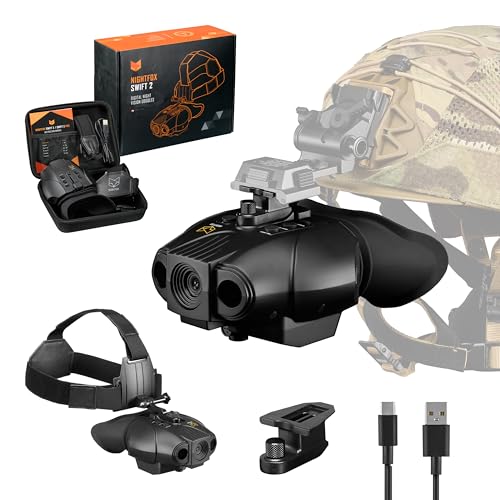
Stay Aware - Our NV infrared goggles have a 1x magnification and an industry-leading 54° wide angle field of view, great for a night vision helmet. Observe your immediate surroundings during security and tactical operations, and while camping or hiking. There's also a 3x digital zoom feature for using the Swift 2 as a binocular.

New for 2026, the Nightfox Prowl 2 - Upgraded IMX662 60FPS sensor, detachable wide-angle and fisheye lenses, screen ON/OFF stowaway sensor, and a sharper LCD with lower latency and increased eye relief. Engineered for fast, clear target ID in high-pressure ops.

【Display Model】: The Gayontech PVS15 Binocular Night Vision is just a Dummy Model with no function, can be used for display or cosplay
The Future of Night Vision Goggle Technology
Night vision goggles are becoming as compact as eyeglasses. Programs like DARPA’s ENVision are developing devices that eliminate bulky units in favor of slim, lightweight designs that resemble regular glasses. These future systems use single flat lenses combined with wide-spectrum sensors to provide enhanced thermal vision and a panoramic viewing experience. Material advancements with titanium, aluminum, and III-Nitride compounds are reducing weight by approximately 30 percent, making them comfortable to wear for extended periods. Sensor fusion technology actively blends image intensifier data and thermal imaging into a single augmented reality display directly in your line of sight. Uncooled sensors now boast 100 times greater sensitivity without relying on heavy cryocoolers, simplifying design and improving reliability. Looking ahead, quantum enhancement could push detection capabilities even further, while integrated OLED displays and more efficient components promise to extend battery life significantly, enhancing operational endurance.