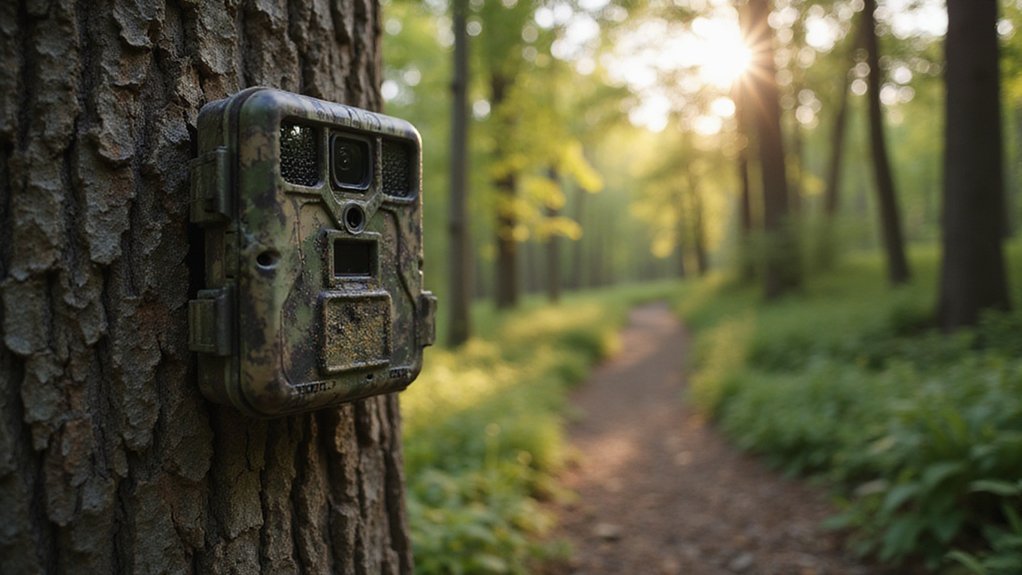
Stealth Cam vs. Muddy: Which Trail Camera Brand Is Better?
If you’re debating between Stealth Cam and Muddy trail cameras, your main concern is likely which one offers better quality and reliability.
Stealth Cam generally outperforms Muddy with sharper images, quicker trigger speeds, and more discreet nighttime infrared.
While both brands share similar app features, Stealth Cam tends to deliver better value overall.
Keep reading to see which fits your budget and needs best.
Why Do Stealth Cam and Muddy Share the Same App and Plans?
Because Stealth Cam and Muddy rely on a shared cellular camera platform behind the scenes, both brands now use the same app—either Command or Command Pro—to manage your devices. This isn’t an accident. Brand differentiation happens in hardware and marketing, not in the software ecosystem. You benefit from app integration that makes managing your cameras straightforward: one account, one login, and a single place to view all your photos and check camera statuses. It doesn’t matter which brand’s logo is on the box. Muddy’s setup videos even direct you to stealthcamcommand.com, which confirms they share the same backend system. You can manage Muddy Matrix or Mitigator cameras alongside Stealth Cam Fusion models from the same app. Feature options depend on your camera’s specific generation, not the brand. So there’s no need to worry about app loyalty—focus instead on choosing the hardware that best fits your scouting needs. For instance, when comparing Stealth Cam vs. Tactacam, users find that performance and cost vary significantly, but the shared platform for these two brands simplifies multi-camera management. To ensure a smooth initial connection, confirm that all three indicator lights turn green, signaling successful battery, cellular, and app linkage before mounting, as this connection confirmation step prevents deployment issues. For those interested in aerial scouting, building your own thermal drone is a viable DIY project for advanced users. A similar hands-on approach applies to ground-based setups, where crafting a custom thermal camera from off-the-shelf components can offer deeper insight into wildlife behavior patterns.
Image Quality: 36MP vs. 24MP and Video Performance Compared
Stealth Cam’s high-end models offer 36MP still images and 1080p video recording, making them strong performers in image quality. The 36MP resolution captures fine details for crisp daytime photos, which is ideal for precise wildlife identification or property monitoring. Their advanced infrared flash produces clear, consistent nighttime images. When it comes to video, the Fusion MAX 2.0 and Connect MAX 3.0 models record in full HD at 1080p and 30 frames per second, delivering smooth footage with clear audio. In comparison, older models like the Fusion MAX record only 720p video. For buyers seeking top-tier performance in low-light conditions, models that combine night vision with thermal offer superior detection capabilities regardless of weather. Muddy’s specifications remain unverified in available sources, so actual megapixel counts and video performance for their models are uncertain. Based on documented specs, Stealth Cam holds an advantage in resolution and video clarity, but you should visit Muddy’s product pages for the most accurate, up-to-date details. For optimal placement, however, reviewing setup guides and tips can help you maximize field performance regardless of brand. If issues arise, the troubleshooting steps for a factory reset on similar trail cameras can restore default settings effectively.

CELLULAR TRAIL CAMERA - Receive photos right on your phone, tablet, or computer via the SPYPOINT app thanks to cellular trail camera technology. Without needing to go into the woods to pull an SD card to see what has been happening in the woods, you can keep an eye on your property, scout for the coming hunting season, or just enjoy watching wildlife from your home, office, or virtually anywhere else you can use your phone.

NATIONWIDE CELLULAR COVERAGE & USA-BASED SUPPORT – Stay connected with Auto Connect technology, ensuring seamless 4G LTE access across all major U.S. networks without swapping SIM cards or buying data plans from an outside company. Moultrie, a USA-based company, offers dedicated U.S. customer support for expert assistance whenever you need it.

CELLULAR TRAIL CAMERA - Receive photos right on your phone, tablet, or computer via the SPYPOINT app thanks to cellular trail camera technology. Without needing to go into the woods to pull an SD card to see what has been happening in the woods, you can keep an eye on your property, scout for the coming hunting season, or just enjoy watching wildlife from your home, office, or virtually anywhere else you can use your phone.
Trigger Speed: Stealth Cam vs. Muddy-Who Reacts Faster?
Stealth Cam cameras react faster than Muddy models in head-to-head tests, with trigger speeds often half or less of Muddy’s. The Stealth Cam Fusion MAX fires in just 0.35 seconds, compared to Muddy’s Mitigator at 0.7 seconds—a 0.35-second advantage. Among their lineups, models like the Stealth Cam Deceptor hit 0.3 seconds, while Muddy’s slowest, the Pro Cam 18, triggers at 1.5 seconds. For capturing fast-moving game, the top end of Stealth Cam’s trigger speeds, around 0.2 seconds, gives you a marked edge. In contrast, Muddy Morph demonstrated the fastest trigger speed among competitors in separate cellular camera tests, often triggering before objects even entered the frame. However, while Stealth Cam offers quicker reaction times, its higher-end models can increase overall costs due to premium components. When comparing these cameras, it is worth noting that the core difference between infrared vs. thermal detection methods can affect how well each brand captures images in total darkness. Thermal imaging technology detects heat signatures rather than reflected light, which means it can reveal animals even in complete obscurity without emitting any visible glow.
However, faster trigger speeds aren’t the only factor. Battery life impacts how long your camera stays operational—faster-triggering models may drain batteries quicker if they fire often. Usability also matters; Stealth Cam’s interface makes it easier to adjust settings quickly in the field, saving you time and frustration. For more predictable scenarios, like waiting at a scrape, Muddy’s slower models still do the job. But if quick reaction time is your priority, Stealth Cam generally reacts faster and helps you record more dynamic, fast-moving activity.

New version trail cam: Clear Day & Night Imaging Capture sharp 64MP photos (adjustable: 5/16/36/48/56/64MP) and smooth 4K HD videos (3840x2160P /2560x1440P). The high-quality optical lens ensures crisp daytime images and night vision performance, making it ideal for wildlife observation, deer scouting, and property surveillance.

30MP Photos & 1080P HD Videos for Clear Wildlife Monitoring:Capture detailed outdoor moments with 30MP high-resolution photos and Full HD 1080P videos. The advanced image sensor delivers clear and vivid images during daytime and reliable performance in low-light environments. This mini trail camera helps capture wildlife activity, deer movement, and outdoor scenes with improved detail, making it ideal for deer scouting, wildlife observation,Garden Monitoring and property monitoring.

Fast trigger speed: The WOSODA trail cameras will be triggered instantly in 0.3s without delay, once detecting the movement, you will never miss any exciting moments even at night, and the trigger distance is up to 60ft.
Which Cellular Plan Fits Your Camera Setup: $5, $8, or $20?
The $20 plan is the best choice for heavy video use and multiple-camera setups. It offers unlimited photos and videos, making it suitable if your camera setup captures frequent footage or if high data transmission is necessary. Additionally, this tier includes discounts for extra cameras, which helps when expanding your system without significantly increasing costs. This plan’s robust capacity is comparable to the stability provided by a cantilever scope mount for heavy optics. Unlike thermal imaging, which detects heat signatures, these cellular plans rely on standard image capture and transmission, so for dynamic surveillance needs, night vision often pairs better with video-heavy data plans due to its ability to record in low light. For long-range monitoring in pitch-black conditions, an infrared illuminator can significantly boost camera performance by providing supplemental light invisible to the human eye.
In comparison, the $5 plan is focused on basic still-photo needs, providing 600 photos per month per camera—adequate for simple motion-activated alerts. It’s ideal if wireless connectivity and low data use are your priorities, and you don’t need video capabilities. The $8 plan sits between these options, but it doesn’t include a clear Stealth Cam option. It’s aimed at setups requiring more frequent image uploads or occasional larger files but doesn’t match the video capacity of the $20 tier.
Choose your plan based on your data demands. Still images keep costs low and are sufficient for basic monitoring, while videos require a higher-tier plan to suit more dynamic or detailed surveillance needs.

【Pinpoint Detail & Built for Observing Wildlife!】 Capture evidence-grade images, stunning 48MP HD resolution photos and 2k videos. Clearly view deer, wild boar, and other animals as they pass by, day or night. The trail cameras with night vision motion activated waterproof built to endure harsh outdoor conditions. And it's the ideal companion for wildlife observers, equipped with a 940nm no-glow infrared LED that does not disturb animals at night

Smart AI Recognition & 7-Day Activity Forecast (Core Upgrade) Powered by advanced AI algorithm, this cellular trail camera automatically identifies various wildlife species in captured footage. It supports 7-day weather and animal activity trend forecasting, paired with high-precision topographic maps, custom positioning markers and intuitive data dashboards. Help you accurately judge wildlife movement rules and efficiently arrange outdoor scouting, searching and observing plans. Note: Cloud storage service is required to activate the AI species detection function.

【Pre-Integrated U.S. 4G Cellular Trail Camera】 The Loatos deer camera comes ready to use out of the box with a built-in SIM, optimized for seamless operation on major U.S. networks. It ensures stable signal reception on Verizon, T-Mobile, and AT&T networks in 4G LTE areas (service is currently available within the United States). No Wi-Fi required. The SIM card enables convenient remote management, while the solar panel provides constant power, making it ideal for remote locations.
Solar Panels and DC Jacks: How to Extend Battery Life Cheaply
To extend your camera’s battery life cheaply using solar panels, choose units that are compatible with your camera’s DC jack, typically 12V. Both Muddy and Stealth Cam offer solar setups designed for 12V DC jacks, but always verify compatibility to prevent inaccurate battery readings. Muddy’s setup includes a 3000mAh lithium-ion battery, and Stealth Cam’s Fieldmax-style unit matches at 3000mAh, providing reliable power through cloudy nights. Fully charged solar panels typically show high battery levels after a month, demonstrating their long-term power solution. Understanding the cost breakdown of these solar accessories helps you avoid overpaying for features you don’t need. For users of both brands, these solar panels allow the scope to maintain accurate readings without voltage drop interference.
For easier mounting, Muddy provides a 6-foot insulated cable that allows flexible placement in sunny spots. Stealth Cam’s external power option also works well, giving you more versatility. Position your solar panel in an open space with direct sunlight—preferably south-facing—to maximize efficiency. An open-sky location ensures your solar extension can run continuously, 24 hours a day, all year round. This setup significantly reduces the need for frequent battery swaps, extending your camera’s operational time.

Compatible with 12V/1A and 6V/1.5A Trail Cameras – Designed for outdoor trail and hunting cameras requiring 12V or 6V DC input. Ideal for wildlife monitoring, deer scouting and remote outdoor surveillance setups.

【𝐒𝐚𝐟𝐞𝐫 𝐚𝐧𝐝 𝐌𝐨𝐫𝐞 𝐄𝐟𝐟𝐢𝐜𝐢𝐞𝐧𝐭】: The VOLT HERO 12V solar panel is made of high-quality monocrystalline silicon material, which can effectively convert sunlight into electrical energy, provide stable and durable power support, and protect the battery life of deer feeder outdoor
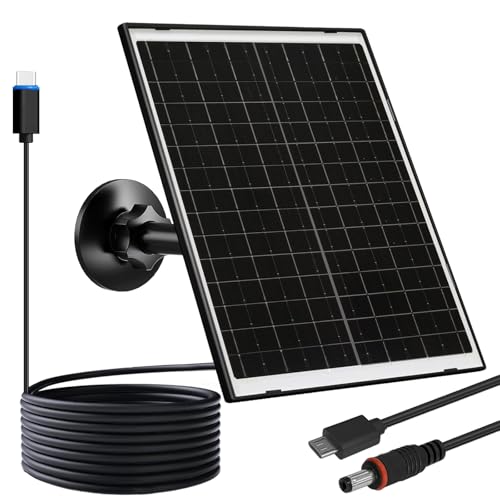
Solar Panel for Trail Cameras & Security Cameras: Our 10W solar panel is compatible with most 5V DC-powered security cameras and trail Cameras, supporting USB-C, Micro USB, and 5.5x2.1mm DC ports. Equipped with multiple connector options, it delivers flexible and reliable power to a wide range of devices, including outdoor security cameras and trail Cameras. Compared to many standard panels on the market, it offers broader compatibility and greater convenience.
Setup Comparison: Stealth Cam vs. Muddy for Beginners
Both Stealth Cam and Muddy offer app-guided setup processes that make initial installation straightforward for beginners. You start by downloading the respective app—Stealth Cam Command Pro for Stealth Cam—and creating an account. Next, you screw on the antenna, insert eight AA batteries, and load an SD card into the camera. To connect the camera to your device, you scan the camera’s QR code using the app. The app then takes care of registration, formatting the SD card, and selecting your plan, so you don’t have to navigate complex physical menus. The camera automatically connects to the best available network (Verizon or AT&T) during initial setup. For a similar activation process, you can follow the Tactacam Reveal camera instructions to scan the QR code and complete registration within its dedicated app.
For mounting, both brands include adjustable straps that let you securely attach the camera to a tree or other stable surface. To ensure your camera operates efficiently and prolongs battery life, it’s a good idea to run a test at home first. This allows you to confirm firmware updates, ensure proper pairing, and get familiar with the controls before deploying it in the field. Spending a couple of days testing at home can save you from wasting a trip, and the app’s prompts guide you through each step clearly and confidently. These trail cameras use infrared light for nighttime detection, a different electromagnetic wave than the image intensification used in night vision goggles. Unlike these models, the Spypoint Flex M requires scanning the camera’s QR code within its own app to initiate the cellular connection and register the device.

【Full Compatibility -Edge Series Cameras】Seamlessly compatible with all moultrie edge cellular trail camera (Edge/Edge Pro/Edge 2/Edge 2 Pro) . Precisely fits original battery slots, Trusted by hunters and wildlife researchers.

TOP-QUALITY GEAR - The HME Trail Camera 12V/Solar Auxiliary Power Pack is a versatile and valuable accessory designed to enhance the performance and longevity of your trail cameras, especially in remote or extended-use settings

【Perfect Compatibility Reveal Battery Pack & LED Power Meter】This high-performance Reveal Battery Pack is perfectly compatible with Tactacam Reveal trail cameras (X Ultra 3.0 , X Gen 3.0, 2.0, X Pro 3.0, Pro, SK, XB, X). Featuring an LED battery meter, it provides a clear visual indication of remaining power. Flashing - charging and Light on -fully charged.
Which Camera Excels at Nighttime: Stealth Cam or Muddy?
Stealth Cam outperforms Muddy for nighttime use. Its models feature low-glow or no-glow infrared systems, making them stealthy and less likely to alert animals. This allows you to capture activity without spooking game. Stealth Cam also benefits from faster trigger speeds and stronger detection ranges, so you can reliably record moving animals from a distance. However, during testing, cheaper Stealth Cam models often produced blurry or blacked-out images from false triggers, compromising reliability in certain scenarios. For those concerned about unwanted surveillance, similar detection methods can be used to identify hidden camera lenses in theatrical settings. A key factor in this performance is the passive infrared sensor that only activates the camera when it detects a heat signature change, reducing wasted shots. By contrast, cameras with color night vision use ambient light and sensors to produce vivid images without the need for infrared flash.
Muddy’s use of a red-glow infrared flash makes its camera more visible at night, which can scare animals away. Its trigger speed of 0.86 seconds is slower, meaning you risk missing quick movements. The recovery time of 69.6 seconds further limits the number of images you can capture in a short span. Although Muddy’s infrared enhances visibility at distances up to 60 feet, it’s less effective than Stealth Cam’s stealthy approach. Overall, when it comes to nighttime performance, Stealth Cam provides superior stealth, speed, and detection.
Value Verdict: Who Delivers More for Your Budget in 2026?
The true value depends largely on your subscription costs and operational needs. When comparing upfront hardware prices, both Stealth Cam and Muddy are similar, typically ranging between $100 and $120 for cellular models. Neither brand offers a significant cost advantage at the moment.
However, the real difference comes down to ongoing expenses. Both brands charge about $68 per month for unlimited photos, video previews, and high-definition downloads. These recurring fees add up over time and can outweigh any initial savings, especially if you’re deploying multiple cameras. For a single unit, this cost may be manageable, but for several cameras, it quickly becomes a substantial expense.
Choosing between them hinges on your priorities. Stealth Cam features an intuitive interface that makes remote adjustments quick and easy, ideal if regular, effortless checks are essential. Muddy, on the other hand, offers slightly better battery life in cold weather, which benefits long deployments without frequent maintenance. Ultimately, if you value ease of use for daily monitoring, Stealth Cam may deliver more bang for your buck; if extended deployment time matters most, Muddy might be the better financial choice. Both brands provide solid utility, but your specific needs ultimately determine which offers the best value.
For users seeking a budget-conscious setup requiring multiple units at minimal cost, the Wosoda Two-Pack Trail Cameras provide an affordable option, though they lack cellular connectivity and remote monitoring capabilities.