PVS-14 vs. PVS-18: Which Night Vision Monocular Is Better?
Wondering which night vision monocular suits your needs best? The PVS-14 is more portable and budget-friendly, while the PVS-18 offers a wider field of view for better peripheral awareness.
Each has its strengths, so your choice depends on what matters most for your environment.
Keep reading to see how these two models compare in optics, mount options, and overall performance.
PVS-14 vs. PVS-18: Which Night Vision Monocular Is Right for You?
The PVS-14 is the more versatile and budget-friendly option for most users. It’s lighter and more portable, making it easier to carry in hand or mount on a helmet without adding significant weight. Its manual gain control allows you to adjust brightness settings quickly, which is useful in dynamic lighting conditions. Support for the PVS-14 is extensive, with many housing kits starting around $700, opening up options for different mounts and configurations. Its proven reliability and well-documented battery life make it a dependable choice for field use. Unlike the PVS-14, which uses a metal housing and manual gain, the PVS-18’s construction is typically polymer with auto brightness similar to the UAN V/M. However, for users deciding between image intensification and heat detection, night vision relies on ambient light to amplify a scene, while thermal imaging detects heat signatures. Beginners should consider that thermal monoculars detect temperature differences, making them effective in complete darkness without any ambient light. Unlike thermal cameras, which use microbolometer sensors to detect infrared radiation, image intensifiers require at least some moon or starlight to function.
In contrast, the PVS-18 offers superior optical clarity thanks to its proprietary optics, which often outperform the glass used in the PVS-14. Its dual dovetail mounting system provides excellent helmet stability, reducing shake and movement during use. While the PVS-18 is more expensive, its clearer image and stable mounting make it a favored choice for applications requiring high precision. However, it is less modular and typically more cumbersome to carry, which might limit portability compared to the PVS-14.

AGM PVS-14 is a rugged, multi-purpose night vision monocular used globally in challenging environments.

CLEARLY IN 100% DARKNESS WITH 7 INFRARED ILLUMINATION LEVELS: Upgraded YUANZIMOO night vision monocular features 850nm IR illuminator, 1.3MP FHD CMOS sensor and 7 gears IR levels adjustment. Brings you a wonderful experience both daytime and 100% darkness in your wild explorations

✅Compatible with the J-arm night vision device interface with a single screw fixation. The chic, mini, and lightweight device features an ergonomic human body engineering design, which is easy to operate.
Why the PVS-18’s 51-Degree FOV Beats the PVS-14’s 40-Degree View
The PVS-18’s 51-degree field of view (FOV) provides a significant advantage over the PVS-14’s 40-degree view. This wider FOV allows you to see more of your surroundings in a single glance, which is especially useful in fast-paced or tight spaces. With that extra 11 degrees, your visual awareness increases substantially, making it easier to spot peripheral movement, obstacles, or doorways without constantly moving your head or monocular. This broader view improves efficiency by reducing the need for frequent pans and scans, helping you track multiple objects and navigate dynamic terrain with less effort. Although a wider FOV can sometimes create a slight fish-eye effect, the benefits of enhanced situational awareness outweigh this minor distortion, helping you stay alert and responsive in critical situations. For instance, understanding why red night vision goggles were banned highlights how certain light signatures can compromise covert operations, reinforcing the need for advanced optics. For those building a drone, integrating thermal imaging sensors can similarly expand your detection range in low-light environments. When selecting between these two models, it is crucial to consider your specific operational requirements to ensure optimal performance.
PVS-14 vs. PVS-18 Optics: Which Is Actually Better?
PVS-14 vs. PVS-18 Optics: Which Is Actually Better?
The PVS-18 offers a more ergonomic design that reduces eye strain during extended use, thanks to its more forgiving eye placement. This makes it a better choice if comfort over long periods matters most to you. However, the PVS-14’s optics are still fully functional, readily available, and more affordable to maintain. The PVS-14S model provides a high FOM (~1600+) for improved dark vision in challenging low-light conditions. Unlike a dedicated unit, the PVS-14 does not rely on a Quick Connect system for mounting, which can simplify setup and reduce potential points of failure. When you do need to mount it, the process is streamlined compared to a typical trail camera setup, which requires more involved placement and angle adjustments. For users who also need to document their view, the PVS-14 can be paired with thermal imagers for iPhone to overlay heat signatures onto the night vision image.
Choosing between them depends on your priorities. The PVS-18 provides a superior optical feel and increased comfort but comes with a higher cost and a smaller aftermarket ecosystem. On the other hand, the PVS-14 balances practical performance with affordability and ease of repair, making it a versatile option for many users.

Gen 2+ Level 1 White Phosphor IIT Equipped with a high-performance P45 white phosphor tube, delivering crisp, high-contrast images in low-light and no-light environments.

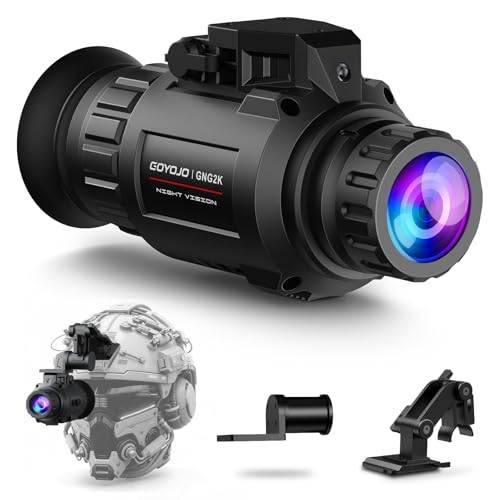
Ultra-Clear 2K Resolution – See What Others Can’t: GOYOJO GNG2K Night Vision Monocular delivers sharp 2688x1520 HD night vision with a smooth 60Hz refresh rate. Whether you’re securing your property, spotting coyotes at night, or navigating a pitch-dark trail, you’ll enjoy crystal-clear visuals without lag or blur — even in total darkness.
PVS-14 Flexibility vs. PVS-18 Stability for Helmet Mounting
Mounting a PVS-14 offers significant flexibility but varies in stability depending on the interface used. The PVS-14 can adapt to bayonet mounts, dovetails, multiple J-arms, and various other mounts. This modularity allows you to fine-tune eye positioning and easily swap configurations or share the device across different setups. You can even add swing-away features for quick removal or adjustment. However, the stability of the mounted device hinges on the chosen interface. A bayonet mount may allow slight wobbling, which can impact precision or comfort. In contrast, a dovetail setup provides a secure, rock-solid lockup, minimizing movement. A typical bayonet mount includes a release lever that is vulnerable to accidental hits, which can cause the device to drop. For those managing multiple devices, a similar connection process can be applied when linking AGM thermal imagers to a smartphone for real-time viewing. The PVS-18 prioritizes stability with a design that emphasizes direct, fixed alignment, much like how a low glow infrared setup provides consistent illumination in darkness. It attaches securely with a more ergonomic setup that reduces movement and chances of accidental disconnects. For a secure fit, you must check that the mount’s torque specifications are met to prevent any slack from developing over time. The tradeoff is clear: the PVS-14’s versatility makes it adaptable for various scenarios, while the PVS-18’s design offers uncompromising stability, ideal for intense field operations.

No need to purchase a J-arm to be compatible with "Dovetail"

Sturdy and Durable: NVG Mount is made of high-quality aluminum alloy with high oxidation resistance, solid , wear-resistant and comfortable, and With this mount, you can say goodbye to loose and wobbly

The night vision device connection bracket mount is made from high-strength aircraft-grade aluminum for superior durability while maintaining a lightweight design - perfect for long-term use without adding unnecessary weight to your night vision device. This premium material is abrasion and impact resistant, ensuring reliable performance in harsh environments.
Which Monocular Runs Longer on One AA Battery?
The PVS-14 runs longer on one AA battery than the PVS-18. While exact runtime figures for the PVS-18 in this configuration are not available, the PVS-14 is known for its efficient power consumption and extended operational time with a single AA. Without definitive data for the PVS-18’s battery life, it’s safe to assume the PVS-14 has the edge. This means you’ll spend less time replacing batteries and more time using your device in the dark. If long battery life is a key factor for your choice, the PVS-14 remains the more reliable option for extended use. For context, much like a trail camera designed for prolonged field use, this device prioritizes efficiency over performance trade-offs. When comparing overall value, the PVS-14 also benefits from a lighter weight and more compact form factor, which are key performance advantages highlighted in head-to-head evaluations of these night vision monoculars. Understanding the drivers of cost for these devices can help you identify which model offers the best long-term savings.
Is the PVS-14 Truly More Reliable Than the PVS-18?
Yes, the PVS-14 is generally considered more reliable for hard use than the PVS-18. Its simpler design means fewer components that can fail. The PVS-14 is a single monocular with no additional linkage, making it mechanically straightforward and easier to maintain. In contrast, the PVS-18 incorporates an integrated dovetail arm, which introduces a potential failure point in the field. Both devices accept the same image tubes, such as the MX-10160 or MX-11796, so image quality depends mostly on the tube choice rather than the housing. While some claim the PVS-18’s lenses are “allegedly better,” users often do not notice a practical difference. Top night vision helmets are often paired with these monoculars to provide stable, hands-free operation in low-light conditions. For rugged, demanding environments, the PVS-14’s proven simplicity provides a notable advantage in reliability. Price gaps between entry-level and high-end units can exceed several thousand dollars, making tube selection a primary cost driver.
Why the PVS-14 Is Easier to Maintain and Find Parts For
The PVS-14 is easier to maintain and source parts for because it uses a standard AA battery and relies on widely published maintenance manuals. Replacing the battery is straightforward—any AA cell will work, so you don’t need proprietary power solutions. Maintenance guides provide clear instructions for cleaning lenses, inspecting optical components, and checking for corrosion or moisture, making routine upkeep manageable even for non-experts. Common wear items like browpads, O-rings, and battery caps are readily available in most parts catalogs, simplifying replacement. Publicly accessible repair guides help you diagnose issues and identify the correct replacement parts without relying on proprietary service channels. User-level maintenance routines involve simple tasks like inspecting, cleaning, and replacing consumables, with no complicated disassembly required. Manuals clearly indicate when lubrication isn’t necessary, reducing potential errors. The combination of fewer proprietary parts and extensive documentation helps you keep your monocular operational longer and at a lower cost. This straightforward design avoids the complex alignment issues that can affect cantilever scope mounts, which require precise torque specifications and specialized tools for proper installation.
Price Breakdown: What You Actually Pay for Each Monocular
The cost of a PVS-14 varies widely depending on the configuration, ranging from about $1,695 for a refurbished Gen 3 model to $9,495 for premium setups. This price range is primarily driven by tube quality; lower-cost options like Gen 2+ models start at the lower end, while high-end versions such as L3Harris unfilmed white phosphor can push the price past $4,000. Your battery life remains fairly consistent across different PVS-14 builds, so increased costs mainly reflect higher specifications and better image quality. For comparison, trail camera costs are also driven by features like sensor resolution and night vision range, but with more transparent pricing across common retail channels. A window camera with night vision often includes integrated infrared illuminators for similar low-light clarity, yet at a significantly lower cost than military-grade monoculars.
In contrast, the PVS-18 lacks transparent public pricing. You won’t find straightforward quotes from vendors, which makes estimating its cost more challenging. Its price depends heavily on surplus channels, the condition of the unit, and the generation of the tube. Because of this opacity, budgeting for a PVS-18 is less predictable.

Versatile Mounting Options: Waterproof, weapon mountable, head or helmet-mountable for hands-free usage
Image Intensifier Tube: Gen 3 Auto-Gated White Phosphor Level 1 technology provides superior image clarity and performance in low-light conditions

LIGHTWEIGHT & COMPACT DESIGN - Built for comfortable extended use while maintaining durability in demanding environments.
Buy the PVS-14 If You Want Affordability: Skip It If You Need Wider FOV
You should skip the PVS-14 if you need a wider field of view. Its 40-degree optics offer a narrower perspective compared to the PVS-18’s 51-degree view. This restriction can hinder peripheral awareness, especially during movement or vehicle operations. While the lower cost makes the PVS-14 appealing for affordability, it sacrifices situational awareness. If seeing more of your surroundings is a priority, investing in the PVS-18, despite its higher price, provides a broader field of view that enhances safety and effectiveness.

Day or Night Viewing - Capture video in both daytime and nighttime modes. Store files directly to a microSD card for easy viewing and sharing.

【Dual IR System for All Day& Night Vision】 Equipped with high-performance 850nm dual IR illuminators , this upgraded night vision monocular delivers immersive full-color viewing in bright daylight and ultra-clear imaging in complete darkness. 9 levels IR adjustments ensure all-scene outdoor exploration, night monitoring and field observation regardless of light conditions.

Enhanced Visual Clarity: 1.54" HD high definition large screen with wider viewing range, equipped with 7x high magnification telescope and 20mm adjustable focus high transmittance photosensitive lens, making it easier to search and find farther targets