Is Digital Night Vision Any Good?
Wondering if digital night vision is worth it? The short answer is yes, especially if you want built-in recording, clear daytime images, and details up to 4K.
You can typically identify targets at 100-200 meters and handle mixed lighting conditions well.
Keep reading to learn what makes a good digital night vision device and how to choose the right one for you.
Is Digital Night Vision Actually Good Enough? (2025 Verdict)
Digital night vision is now genuinely good enough for most users. If you prioritize recording capabilities and daytime versatility over absolute low-light excellence, modern digital units deliver. They feature sharp image resolutions, ranging from 1080p to 4K sensors, providing crisp detail that can identify targets at about 100 to 200 meters. However, digital night vision heavily relies on infrared illumination in total darkness; without infrared LEDs, it struggles more than traditional analog tubes. This reliance on infrared offers benefits like built-in video recording and compatibility with daytime use, which analog devices simply cannot provide. While analog tubes use ambient light to amplify images naturally, digital night vision requires active infrared sources to see in complete darkness. Unlike analog tubes, which instantly amplify even faint starlight, digital sensors need significant light to produce a usable image. Battery life typically lasts between 3 to 8 hours but can be extended with external USB power banks. Modern models like the Nightfox Prow 2 offer the best value by balancing cost and capability. For users building custom setups, integrating a digital camera onto a DIY thermal drone can enhance target detection in low-light environments.

WiFi App Live Viewing and Sharing — Connect these WiFi night vision goggles directly to your smartphone to view live footage, take photos, record videos, and download saved files through the app. Photos and videos can be stored locally on the device/microSD card and your phone, with no cloud upload or subscription required for file transfer, helping keep your files on your own devices. Ideal for nighttime animal viewing, family camping, hiking, backyard animal watching, and nature learning. A practical back-to-school gift for teens and a thoughtful outdoor gift for dads, husbands, campers, and nature lovers.
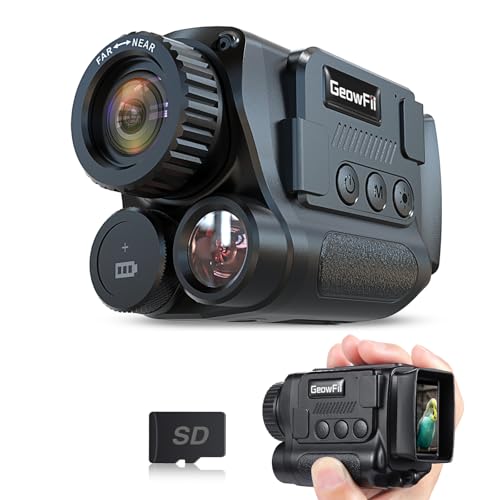
4K Upgraded & Practical—— GeowFiiTech Night Vision Monocular features a 4K version with a 25mm multi-coated lens, enhancing imaging for day and night use. With 4K video, 40MP photos, and essential functions, this monocular night vision meets outdoor needs effectively

Built-in Compass for Easy Navigation – Our 4K digital night vision binoculars feature a built-in compass, ensuring you stay on track in the wild. Whether for tactical use, infrared (IR) night hunting, or outdoor adventures, these nocturna nightvision goggles provide reliable navigation in complete darkness.
What Most People Get Wrong About Digital Night Vision Quality
Processing delay is a major factor that most users overlook. When your device has a noticeable lag during movement, it feels unnatural and can disrupt your situational awareness. This delay can cause you to miss quick changes or threats in real time. A custom-built security box can help stabilize the device and reduce accidental movement that worsens lag perception. For example, Ring cameras use active IR LEDs to produce a clear black-and-white image, but the delay can still affect the responsiveness of real-time footage.
Infrared (IR) effectiveness is crucial; active IR is necessary to produce a usable image, but it also risks revealing your position to others using similar gear. Without strong IR illumination, your image quality drops significantly, making it harder to identify details in low-light conditions.
Bright lights can easily wash out the sensor, washing away all your detail and clarity. Additionally, high power consumption during operation reduces battery life, cutting your operational time short exactly when you need it most. However, digital sensors avoid tube damage from bright lights, lasers, or IR exposure, unlike fragile analog tubes.
Ultimately, evaluate night vision gear based on real-world performance limits rather than marketing promises or brochure specifications.
5 Scenarios Where Digital Night Vision Beats Analog Hands Down
Digital night vision excels in five specific scenarios where it outperforms analog. First, you can safely navigate mixed lighting environments, such as streetlights and headlights, without risking tube damage. Digital devices handle fluctuating light levels better, ensuring clearer images without risking the fragile tubes that analog relies on. This is because digital sensors are not vulnerable to bright light damage like analog image intensifier tubes, which can be ruined by exposure to bright sources. Second, digital night vision offers an affordable entry point for low-light tech, making it accessible if you don’t need elite tactical features but still want decent visibility. Third, it allows you to record videos and photos directly, which is ideal for content creation, documentation, or sharing. Wireless streaming is a key advantage here, enabling real-time sharing of footage with others without extra equipment. Fourth, you can safely use digital night vision in daylight, providing versatility for different lighting conditions. Its rugged build also offers some protection against rough handling and misuse, though shorter battery life compared to analog is a trade-off. Fifth, digital technology is well-suited for static wildlife observation or surveillance under ambient light, delivering clear visuals without requiring rapid head movement or quick response times.
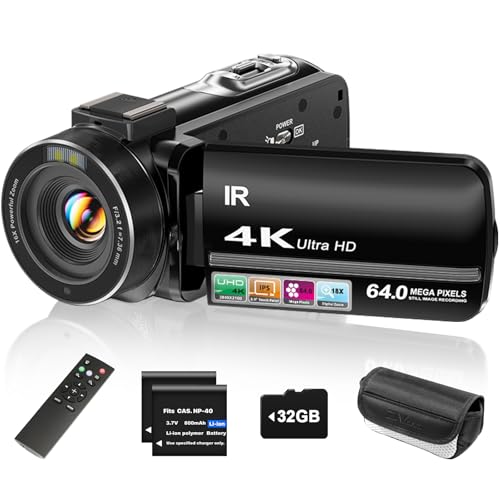
4K & 64MP Video Camera Camcorder: Capture life in breathtaking detail with 4K Ultra HD recording and vibrant 64MP photos, powered by an advanced high-sensitivity CMOS sensor. Equipped for exploring the beautiful world, this video camera is your perfect companion! Ideal for video recording, travel vlogs, family activities, interviews, studying, and cherishing precious moments

【5K Cinematic Clarity & Versatility】 This digital camera captures stunning 5K/20fps videos (also 4K/60fps) and 64MP photos with a high-sensitivity CMOS sensor. Perfect for vlogging, travel films, podcast recording, family events, and interviews, delivering cinema-grade detail even in motion.

【Full HD 1080P 24MP Video Camcorder】This video camera supports up to 1080P video resolution and 24.0MP image resolution. The 18X digital zoom can enlarge the picture to capture all the important details.This vlog camera is the perfect companion when exploring this beautiful world! A plethora of features including Infrared Night Vision, continuous shooting, webcam function, remote control, pause function, loop recording
When You Should Still Buy Analog Instead of Digital
Analog is still a strong choice when budget isn’t the primary concern. Its low-light performance surpasses digital options, especially in moonless conditions, thanks to its larger sensors and optical design. You’ll also benefit from longer battery life—up to 20 hours on quality AAs—making it well-suited for extended patrols where power sources might be scarce. Unlike digital devices, analog units do not rely on IR illumination that can be detected by others, offering a covert operation advantage in tactical scenarios.
Motion fidelity is another advantage. Analog viewing offers zero lag, making it feel more natural during close-quarters navigation or when making rapid head movements. You won’t experience the processing delays typical of digital devices. Keep in mind, however, that analog tubes are vulnerable to damage from bright light sources, so handling with care and controlling the environment is necessary.
If you’re investing over $2,000 in a high-end device for clarity and endurance, analog remains a reliable choice. Its durability and performance under specific conditions continue to make it worthwhile despite the digital shift.
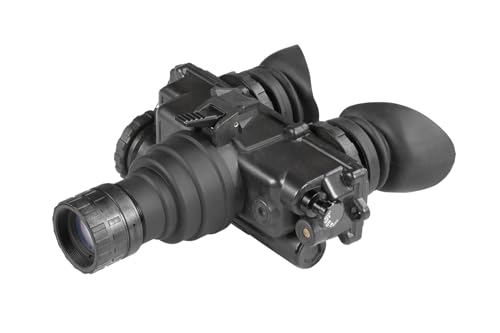
U.S. Military-Grade Night Vision Reliability: Crafted to meet the rigorous demands of the U.S. Military, the AGM PVS-7 night vision goggles deliver unmatched performance and dependability in the field. This rugged, battle-proven device is your trusted companion for secure and precise night operations

Dual Tube Gen 2+ Level 1 System Delivers exceptional clarity and depth perception using Gen 2+ Level 1 IIT, perfect for tactical, surveillance, and night patrol operations.

AGM PVS-14 is a rugged, multi-purpose night vision monocular used globally in challenging environments.
Digital Night Vision: Where It Shines in Low Light (And Where It Fails)
Digital night vision performs poorly in complete darkness. Without built-in infrared (IR) illumination, image noise and fuzz increase significantly, making it difficult to distinguish details. The field of view also feels more limited compared to analog devices, which can give a narrower perspective. While digital night vision works well in low light conditions, it struggles when there is no ambient light and IR is absent. To achieve optimal results, ensure there is some form of ambient illumination or use IR illumination, as these help the sensor produce clearer images and better target identification. Even in favorable low-light settings, digital models suffer from a noticeable processing delay and tearing that hinders real-time observation of moving subjects, unlike lag-free analog alternatives. For users who require a reliable tool in absolute darkness, a thermal scope with LRF provides superior detection that does not depend on any ambient light. When comparing costs, digital devices are generally more affordable because they use less expensive components such as CMOS sensors rather than intensifier tubes. For trail camera applications, the Tactacam Reveal 3.0 offers a strong balance of performance and cost for users needing reliable daytime and low-light capture.
Digital Night Vision Latency: Why Frame Rate Matters Most
Frame rate is crucial in digital night vision because it directly impacts how smoothly motion appears. A system operating at 30 Hz provides about 30 frames per second, which can result in choppy movement when you quickly turn your head or move the device. This choppiness creates a disconnect that feels jarring and can hinder quick target tracking. At low frame rates, pixel persistence increases, causing fast-moving objects to blur or smear across the display, reducing clarity and situational awareness. Unlike analog intensifier tubes in gear like the PVS-14, digital units lack the instantaneous response of analog night vision, which can make the latency gap more noticeable during rapid head movements. Night vision goggles rely on near-infrared light to illuminate scenes that are invisible to the human eye, giving digital sensors the data they need to form an image. For many users, the best gopro camera with night vision emphasizes high frame rates to overcome these digital limitations in fast-paced scenarios.
For handheld or head-mounted units, poor frame rates also hinder image stabilization, as the sensor struggles to keep up with rapid movements. This sluggish response makes the view feel sluggish and less responsive to your motions. Conversely, higher frame rates like 60 or 100 Hz significantly reduce lag, allowing for more natural tracking. They minimize motion blur and provide a smoother, more stable image, which is especially beneficial during active tasks such as hunting or tactical operations. Although increasing the frame rate can slightly compromise low-light sensitivity, the benefit of improved speed and fluidity often outweighs this trade-off for demanding nighttime activities. For instance, a digital unit like the ADNV G14SE achieves a maximum refresh rate of 100 fps to effectively reduce latency and feel nearly lag-free during movement.
How Much IR Does Your Digital Night Vision Need to Work in the Dark?
Your digital night vision requires enough IR illumination to function effectively in total darkness. The infrared intensity you set directly impacts how far you can see. For close-range viewing, use a low IR setting to prevent image washout. When observing mid-range scenes, select a medium IR power with a broader beam. For long-distance observation, higher IR power with a narrow, focused beam is necessary to keep energy concentrated and maximize visibility. Adjust your IR illumination according to your distance: a wide flood beam for close ranges and a tight spot beam for long-distance viewing. If your image appears dark and grainy, you likely need more IR illumination. Conversely, if your view shows a harsh white center with dark edges, you are using too much IR. Start by lowering the IR power, then fine-tune your beam size to match your specific distance. When comparing thermal options, Pulsar vs. AGM will help you decide based on performance and cost.
How to Spot a High-Quality Digital Night Vision Unit (Without Overpaying)
The most important features to look for in a high-quality digital night vision unit are sensor size and display resolution. A larger sensor, ideally 1-inch-class or bigger, captures more light, resulting in better detail in low-light scenarios. This is foundational for clear imaging even in complete darkness. The display resolution also matters because it determines how sharp and clear the image appears. Higher micro-display resolutions reduce blockiness and allow you to see fine details at longer distances. For example, the MVG90 Pro uses a 1-inch ultra high-performing SOMO sensor that rivals the performance of Gen 3 analog tubes.
Exceptional units maintain readable images even at great distances, whereas cheaper models quickly lose clarity. Some advanced units also offer full-color night vision, which can enhance recognition and detail in low-light conditions. Additionally, check for low latency and high frame rates, between 90 and 100 frames per second (fps). Higher fps ensures smoother motion, important for quick movement or tracking. When comparing options, remember that red or green hunting lights serve a different purpose entirely, as they are external illuminators for traditional scopes rather than built-in digital sensors.
Finally, a wide field of view—around 40 degrees or more—helps you observe more of your surroundings without needing to scan constantly. Focusing on these specifications will help you identify quality digital night vision units without overpaying.

Spy Cam Tiny - The Mini Cam is the Very Small Compact Size Portable Sport Body Camera(0.89 x 0.89 x 0.89 inches), Which Makes It Perfect as a House Security Cam for Working Both Take Quality Daylight Full HD Videos and Full HD 1080P Photos.

【Smart and Convenient】: This 2.4GHz Wifi smart doorbell camera with a 4.3-inch display monitor offers wireless night-time PIR motion detection. It's equipped with Tuya APP wifi connection, allowing you to remotely view, talk, take photos, and record videos, providing you with a smart and convenient way to monitor your home.
Digital Night Vision vs. Analog: Which One Fits Your Use Case?
Choosing between digital and analog night vision depends on your specific needs. Analog units excel in complete darkness, providing a smooth, natural image with no delay. They offer immediate display clarity, which is essential for quick movements and fast reaction times. However, they are sensitive to bright lights and can be easily overwhelmed or damaged by sudden flashes. Digital night vision, on the other hand, delivers a crisper image on the screen but introduces a slight lag, which can affect your response time. It also performs better in mixed lighting conditions or when using infrared illumination. Keep in mind that digital devices consume more battery power due to their sensors and displays, resulting in shorter operational durations compared to analog systems. For tactical, ultra-low-light applications where raw darkness capability is crucial, analog is the preferred choice. If you need modern features, recording capabilities, or flexibility in varying lighting situations, digital night vision becomes the better fit. Additionally, digital sensors like the Sony Star Viz 2 can detect emitted infrared signals up to roughly 1885 nm, which is valuable for identifying covert IR activity invisible to the naked eye. When selecting a camera for outdoor monitoring, you should also consider game camera reviews that compare quality and performance across different brands. Enthusiasts can even explore DIY thermal camera projects to understand the sensor and lens requirements for building their own night vision system. Understanding trail camera costs helps you budget for features like digital versus analog technology without overspending.

High-definition night vision:Designed for camping, hiking, wildlife watching, backyard observation, and other outdoor activities, this night vision binoculars features a high-sensitivity CMOS sensor and 7 levels of adjustable infrared night vision for enhanced visibility in low-light and nighttime conditions. The night vision camera records 4K video at 25 fps and captures 64MP photos, recording wildlife, camping experiences, hiking discoveries, nighttime activities, and other exciting outdoor moments

Advanced Night Vision Imaging Technology:Equipped with an 850nm infrared illuminator and Starlight CMOS sensor, these goggles deliver full-color visibility in low-light conditions and 7 adjustable IR levels for clear observation up to 2,000 feet (610 meters) in total darkness that ensures durability for nighttime adventures

NIGHT VISION GOGGLES FOR ADULTS 4K – Experience clear digital night vision with a 4K imaging system and large 4.5" HD screen. Designed for nighttime observation, outdoor exploration, camping, hunting, and wildlife viewing.
The Bottom Line: Is Digital Night Vision Good Enough for You?
Digital night vision is generally not suitable for fast-paced or tactical scenarios. Low-end devices tend to cause disorientation and suffer from latency issues, making them unreliable when quick movements are involved. If you mainly want to record and observe without needing peak low-light performance, digital options can suffice. However, for silent, lag-free viewing in complete darkness, analog night vision remains the better choice. Your need for rapid response versus casual observation will determine if digital night vision is good enough for your specific situation. For instance, higher-end digital units like the InfiRay DNVS 14 Pro can achieve about 85% of real-world performance, offering long-distance identification with minimal image degradation. Budget-conscious users might consider Vivitar options that balance cost with basic night vision recording capabilities. Scouting with digital night vision requires reliable battery management to ensure extended field use without unexpected power loss. Understanding thermal drone costs can inform your overall budget if you plan to pair night vision with an aerial platform.